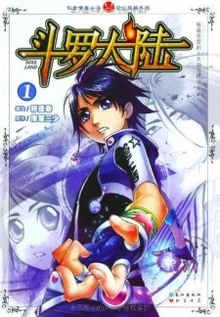
Type: Manhua
Status: ongoing
Author(s): Tang Jia San Shao
Artist(s): Mu Feng Chun
Released: 2011
 Support US
Read Douluo Dalu Manga Online
Battlelands, Combat Continent, Das Land der Seelen, Dou Luo Da Lu, Douluo Continent, Lands of Battle, Soul Land, Боевой континент, 斗罗大陆, 斗羅大陸
Synposis:
Tang San spent his life in the Tang Outer Sect, dedicated to the creation and mastery of hidden weapons. Once he stole the secret lore of the Inner Sect to reach the pinnacle of his art, his only way out was death. But after throwing himself off the deadly Hell's Peak he was reborn in a different world, the world of Douluo Dalu, a world where every person has a spirit of their own, and those with powerful spirits can practice their spirit power to rise and become Spirit Masters.\n\nThe spirit that awakens within Tang San is Blue Silver Grass, a useless spirit. Can he overcome the difficulties to reach the high ranks of Spirit Masters and bring the glory of the Tang Sect into this new world?
Type: Manhua
Status: ongoing
Author(s): Tang Jia San Shao
Artist(s): Mu Feng Chun
Released: 2011
Douluo Dalu Chapters
Douluo Dalu (Soul Land)
Douluo Dalu (Simplified Chinese: 斗罗大陆; Traditional Chinese: 斗羅大陸), known internationally in English as Soul Land, is a foundational Chinese xianxia and xuanhuan manhua adapted from the web novel by Tang Jia San Shao (Zhang Wei). Illustrated by Mu Feng Chun and produced by Zhiyin Animation / Feng Lin Huo Shan, the original manhua began serialization in Zhiyin Manke in 2010. Across over 340 serialized chapters (often split into multiple sub-parts online), the series bridges Eastern martial arts cultivation with Western-inspired RPG progression mechanics, establishing itself as a pillar of modern Chinese digital comics.
What begins as a classic reincarnation revenge and survival story—following a disgraced Tang Sect disciple reborn into a world governed by innate spirits—gradually scales into a sprawling geopolitical and divine epic. While early arcs center on academy tournaments, adolescent camaraderie, and creative tactical combat, the narrative expands into continent-spanning warfare against an authoritarian religious empire and eventual ascension to godhood, setting the blueprint for multi-generational transmedia storytelling in Chinese web fiction.
Latest Douluo Dalu Updates & Serialization Status
-
Serialization Status: The primary Douluo Dalu manhua adaptation is in its final narrative stages, having surpassed 345 main chapters (often indexed past 700+ sub-episodes on international aggregators due to chapter splitting). While the original web novel concluded in 2009 with 336 chapters, the manhua experienced periodic hiatuses and pacing expansions during its final war and divinity arcs, maintaining an irregular bi-weekly to monthly update cadence on Tencent Comics and Kuaikan Manhua.
-
Franchise & Media Expansion: The Soul Land IP operates as a massive multimedia ecosystem. Sparkly Key Animation produced the landmark 3D donghua adaptation on Tencent Video (WeTV), which ran for 263 episodes before concluding with a theatrical-grade finale movie, Soul Land: Battle of the Gods. The franchise has expanded into four direct manhua and donghua sequels—Douluo Dalu II: The Unrivaled Tang Sect, Douluo Dalu III: The Legend of the Dragon King, Douluo Dalu IV: Ultimate Fighting, and Douluo Dalu V: Rebirth of Tang San—alongside a live-action Tencent drama starring Xiao Zhan and multiple mobile MMORPGs.
Story Overview & Core Narrative Arcs
In his previous life, Tang San was an outer-sect disciple of the prestigious Tang Sect who stole forbidden inner-sect secret arts to construct the ultimate hidden weapon, the Buddha Fury Tang Lotus. Cornered by sect elders, he leaped from Hell’s Peak to preserve his honor, only to awaken in the Douluo Continent with his past-life memories and martial arts techniques intact. In this world, every individual awakens a Martial Soul at age six, determining their social status and potential to become a revered Soul Master.
-
Awakening & Academy Foundations: Tang San awakens twin martial souls—the seemingly useless Blue Silver Grass and the legendary Clear Sky Hammer—and enrolls at Notting Junior Soul Master Academy, where he meets the theoretical genius Yu Xiaogang (Grandmaster) and his lifelong companion, Xiao Wu.
-
The Shrek Seven Devils: Assembling at the impoverished yet elite Shrek Academy, Tang San unites with six prodigious peers to form the Shrek Seven Devils, utilizing unorthodox training and Tang Sect hidden weapons to overcome superior aristocratic academies.
-
The Continental Advanced Soul Master Academy Elite Tournament: The core squad enters the continent-wide championship, exposing internal corruption within the Spirit Hall and triggering the tragic sacrifice of Xiao Wu when her true identity as a 100,000-year Soul Beast is revealed.
-
The Sea God Island Trials: Seeking the strength to resurrect Xiao Wu and dismantle Spirit Hall’s tyranny, the Shrek Seven Devils journey across the ocean to Sea God Island, enduring grueling divine trials that elevate them into Title Douluos.
-
The War of Double Gods: Spirit Hall reorganizes into the Spirit Empire to conquer the Heaven Dou and Star Luo Empires, culminating in a cataclysmic clash between Tang San (inheriting the Sea God and Asura God thrones) and Bibi Dong (Rakshasa God) alongside Qian Renxue (Angel God).
Main Characters in Douluo Dalu
Tang San is the disciplined, calculating protagonist who fuses Tang Sect hidden weapons, poison mastery, and Mysterious Heaven Skill cultivation with Douluo Continent’s soul ring mechanics. Driven initially by a desire to protect his alcoholic blacksmith father, Tang Hao, and honor his mentor’s theories, Tang San’s motivation evolves into an unyielding resolve to revive his soulmate Xiao Wu and dismantle systemic oppression. His internal conflict frequently balances cold, pragmatic lethality against fierce loyalty to his found family.
Bibi Dong, the Supreme Pontiff of Spirit Hall and later Empress of the Spirit Empire, serves as the series’ primary antagonist. A tragic and ruthless visionary, she is the only other known wielder of Twin Martial Souls (Death Spider Emperor and Soul Devouring Spider Emperor). Embittered by past trauma inflicted by her former mentor Qian Xunji, Bibi Dong seeks to eradicate the traditional noble clans and unify the continent under absolute authoritarian rule, positioning herself as a dark mirror to Tang San’s tactical brilliance.
Yu Xiaogang (Grandmaster) acts as the ideological backbone and mentor of the series. Born into the elite Blue Lightning Tyrant Dragon Clan with a mutated, stunted martial soul stuck below Rank 30, he endured decades of ridicule while compiling the Ten Core Competencies of Martial Souls. By taking Tang San as his disciple, Grandmaster proves that theoretical knowledge and tactical synergy can overcome innate genetic limitations.
Lore, Power Systems, and World Mechanics
Douluo Dalu replaces vague spiritual enlightenment with a quantified, rule-bound progression system centered on Martial Souls, Soul Power, and Soul Rings. At age six, a child awakens an inherited spirit—ranging from tools and weapons (Tool Souls) to animals and plants (Beast Souls)—alongside an innate soul power level between 1 and 10.
-
Soul Ring Absorption & Ranks: Every 10 levels of Soul Power requires hunting a Soul Beast and absorbing its Soul Ring to unlock a new Soul Skill and advance to the next tier: Soul Scholar (1–10), Soul Master (11–20), Soul Grandmaster (21–30), Soul Elder (31–40), Soul Ancestor (41–50), Soul King (51–60), Soul Emperor (61–70), Soul Sage (71–80), Soul Douluo (81–90), and Title Douluo (91–99).
-
Ring Color Hierarchy: Soul Rings are strictly categorized by the age of the slain beast: White (10-year), Yellow (100-year), Purple (1,000-year), Black (10,000-year), Red (100,000-year), and Gold (1,000,000-year / God-level). Exceeding safe age limits during absorption risks bodily explosion.
-
Soul Bones: Extremely rare artifacts dropped by powerful Soul Beasts (skull, torso, left/right arms, left/right legs) that grant permanent passive enhancements and additional skills without occupying ring slots.
-
Deep Mythos & Divine Realm: Above the mortal Douluo Continent sits the God Realm, governed by a committee of First-Class Gods and Five God Kings (including the Asura God and Sea God). Mortals who reach Rank 99 Limit Douluo can inherit divine thrones by passing elemental or moral trials, ascending beyond mortal lifespan limits.
Narrative Framework & Progression Appeal
The enduring appeal of Douluo Dalu stems from its strict adherence to tactical problem-solving over arbitrary power-ups. Because Tang San possesses a low-tier plant spirit (Blue Silver Grass) during the first half of the story, he cannot overpower opponents through brute force; instead, every battle operates like a high-stakes puzzle involving battlefield control, poison application, and team synergy.
-
Clear Milestone Benchmarks: The 10-rank tier system and color-coded Soul Rings give readers immediate visual and numerical clarity regarding a character’s strength and the danger level of any encounter.
-
Synergistic Team Combat: Unlike solo power-fantasy protagonists, Tang San functions as a Control-System Soul Master who relies on Assault, Agility, Defense, and Support teammates to execute multi-layered formations.
-
Cross-System Innovation: Watching Tang San integrate past-life Tang Sect concealed weapons (such as Zhuge Godly Crossbows and阎王帖 / Yama’s Invitation) disrupts the conventional rules of the Douluo world, creating satisfying asymmetrical upsets.
-
Risk-Reward Cultivation: Absorbing over-aged Soul Rings—such as Tang San absorbing a 10,000-year Black Ring as his fourth ring—creates visceral physiological tension rather than effortless leveling.
-
Earned Emotional Payoffs: Multi-arc investments, such as Tang San’s years-long quest to gather divine herbs and resurrect Xiao Wu, anchor the action in genuine emotional stakes.
Franchise Identity & Production Quality
Illustrator Mu Feng Chun established a distinct visual identity for the Douluo Dalu manhua that diverges sharply from both the original novel’s grittier tone and the realistic 3D aesthetic of the Sparkly Key donghua. The manhua leans into vibrant, expressive, and slightly comedic character designs during slice-of-life segments before shifting into intricate, high-contrast linework during Soul Skill activations.
-
Dynamic Visual Coding: Soul Rings are rendered as glowing, concentric halos around characters, allowing readers to instantly assess power disparities during multi-character clashes.
-
Tonal Flexibility: The manhua balances slapstick academy humor—particularly around Oscar’s food-based Martial Soul incantations and Ma Hongjun’s antics—with dramatic, full-page spreads for pivotal sacrifices.
-
Creative Continuity: Despite occasional assistant rotations during later arcs, Mu Feng Chun’s foundational character silhouettes and costume designs remained iconic enough to influence official merchandise and mobile game character models.
-
Pacing Adaptation: While the manhua alters certain minor novel plot points—such as adding unique trial mechanics in Sea God Island—it preserves the core thematic beats of perseverance and brotherhood.
-
Transmedia Synergy: Cross-promotion between the manhua, the record-breaking Tencent donghua, and interactive mobile games created a continuous feedback loop that introduced millions of casual viewers back to the serialized comic.
Setting & Societal Impact
On the Douluo Continent, Soul Masters sit at the apex of socioeconomic and political hierarchy. Ordinary civilians without innate soul power work as farmers, merchants, or artisans, relying on Soul Masters for protection against encroaching Soul Beast territories like the Star Dou Great Forest.
-
Tripartite Geopolitics: Political power is divided between two major monarchies—the Heaven Dou Empire and the Star Luo Empire—and the supranational Spirit Hall, which acts as both a religious authority and a global registry that issues monthly gold coin stipends to low-ranking Soul Masters.
-
Aristocratic Bloodline Supremacy: Elite clans such as the Clear Sky Clan, Seven Treasure Glazed Tile Clan, and Blue Lightning Tyrant Dragon Clan monopolize top-tier Martial Souls, creating deep class divides against commoner-born students.
-
Ecological Tension: Because advancing in rank requires killing Soul Beasts for their rings, human civilization exists in a state of perpetual ecological warfare with intelligent, millennia-old beasts.
-
Institutionalized Competition: Continental academy tournaments serve as both public entertainment and diplomatic leverage, allowing empires to scout future military commanders.
-
Technological Stagnation vs. Hidden Weapons: Reliance on innate Martial Souls led to minimal mechanical innovation across the continent until Tang San introduced Tang Sect mechanical weaponry, permanently altering military warfare.
Why Douluo Dalu Is So Popular
-
Gateway to Chinese Manhua: For many international readers, Douluo Dalu served as their first introduction to Chinese xuanhuan comics, bridging familiar shonen tournament tropes with Eastern cultivation lore.
-
Accessible Power Mechanics: The 1-to-99 rank structure and color-coded rings eliminate the confusing terminology barriers often found in traditional cultivation manhua.
-
Memorable Ensemble Cast: Rather than sidelining supporting characters, the Shrek Seven Devils each receive dedicated character arcs, specialized combat roles, and divine inheritance paths.
-
Iconic Donghua Momentum: The 3D animated series amassed over 50 billion views on Tencent Video, consistently driving massive waves of viewers to read ahead in the manhua.
-
Generational World-Building: Readers invested in Tang San’s story can seamlessly follow his descendants and legacy across four full-length sequel series spanning tens of thousands of years.
Where to Read Douluo Dalu Officially
-
Tencent Comics (Ac.qq.com): The primary official Chinese digital publisher hosting the complete serialized manhua.
-
Kuaikan Manhua: Official domestic digital distribution partner carrying high-resolution chapters.
-
WebComics & MangaToon: Authorized English digital platforms offering officially translated chapters for international mobile and web readers.
-
Bilibili Comics (Archive/Partner Licensing): Previously distributed official English chapters; availability varies by regional licensing windows.
-
Print Volumes (Simplified Chinese): Published physically in mainland China via Zhiyin Manke and Hunan Fine Arts Publishing House in collected tankobon editions.
Final Thoughts
Douluo Dalu stands as one of the most influential transmedia properties in modern Asian pop culture. By codifying Martial Souls, Soul Rings, and team-based tactical combat into an intuitive progression framework, Tang Jia San Shao and Mu Feng Chun created a template that reshaped both Chinese web fiction and the domestic manhua industry. Even over a decade after its debut, its blend of underdogs defying bloodline elitism and deeply earned camaraderie remains compelling.
As the primary Douluo Dalu manhua wraps up its final divine battles, the broader franchise shows no signs of slowing down. With Douluo Dalu II: The Unrivaled Tang Sect and Douluo Dalu III: The Legend of the Dragon King continuing active serialization across both manhua and 3D donghua formats, new generations of readers continue to enter the Soul Land universe, cementing its legacy as a cornerstone of global digital comics.